What our copper products are made of
Where our copper comes from and what independent laboratories measured. Including the composition analyses from 2021 and October 2026 and food-contact testing from April 2026.
Written and source-checked by the Kopero editors · Updated November 22, 2026

You drink from it every morning, or you wear it on your wrist all day. Then you are entitled to know what is in it. Not "high-quality copper", but the number, the lab that measured it and the standard it was tested against.
That is why we explain which material we use, where it is made and what the independent laboratories reported. Alongside the original 2021 measurement, you will also find our new check from October 2026.
In short
- Everything is solid copper.
- Two composition measurements: RTC measured 99.21% copper and 0.75% zinc in 2021; URS measured 99.18% copper and 0.498% zinc in October 2026.
- URS examined the water bottle, mug and pyramid separately for food contact.
- Nineteen heavy metals were measured in the water that had been standing in the product. Not one was detectable.
- On odour and taste they scored 0, on a scale where 2.5 is still permitted.
What our products are made of
Everything we sell is made from solid copper, rather than a thin copper layer over another metal. Its warm shine can develop a distinctive patina with use. You can let that patina grow or polish the shine back.
| Laboratory | Date | Copper | Zinc |
|---|---|---|---|
| RTC Laboratory | 16 June 2021 | 99.21% | 0.75% |
| URS Products and Testing | 21 October 2026 | 99.18% | 0.498% |
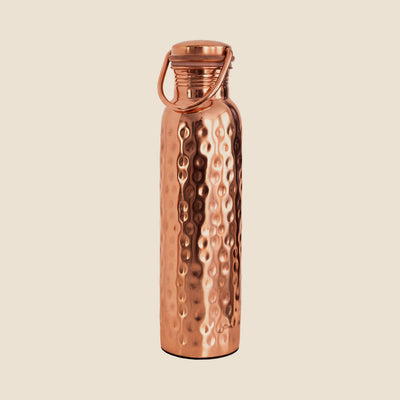
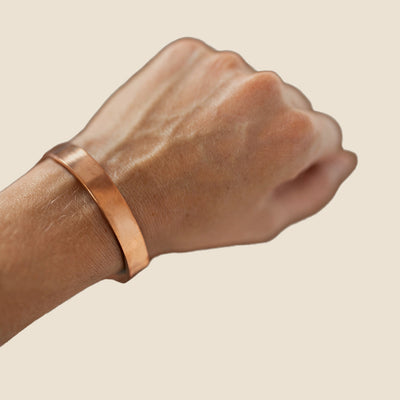
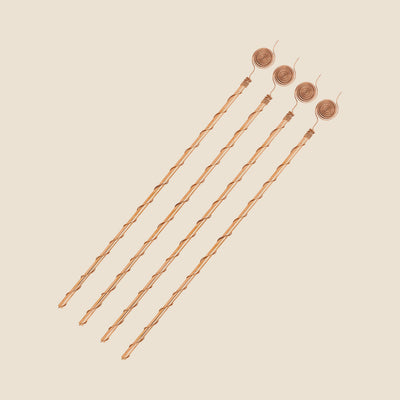
We use the same type of solid copper for the water bottle, cup, mug, jug, bracelet, tongue scraper, pyramids, tensor ring and electroculture stakes. The products come from the same workshop; their shapes and finishes differ.
A very thin, transparent protective finish helps preserve the shine during storage and transport. On the outside only; the inside is bare copper, without lacquer or plastic lining. The handles are protected; the scraping part is bare copper. Smooth, Hammered and Twisted: protected outside, bare copper on the skin side. Round: transparent protection all around.
Why it is not 100%
Solid copper means that the copper part is the same material throughout, rather than another base metal with only a copper layer. This is not the same as a chemical purity of exactly 100%. The composition measurements show predominantly copper and a small proportion of zinc.
For comparison: brass, which many cheap "copper" products are made of, is 30 to 40% zinc. That is an entirely different material with an entirely different colour. What to look out for when buying copper yourself is in How to recognise real copper.
Where the copper comes from
Our products are made in Moradabad, in the Indian state of Uttar Pradesh. That city is known in India as Peetal Nagri, the copper city, and for good reason: people have worked copper and brass there for centuries, and the craft passes from one generation to the next. The hammer marks on our hammered finishes are set by hand, one at a time.
Exactly who we work with we keep to ourselves, for the same reason most brands do. What we can show is what was measured in the material, and by whom.
What was tested
The composition
RTC Laboratory in Moradabad measured the composition. It is a division of the Metal Handicrafts Service Centre, which falls under India's Ministry of Textiles, and it is NABL-accredited to ISO/IEC 17025:2017 under certificate number TC-6683. Tested to ASTM-1621 and IS-228.
The first composition measurement dates from 16 June 2021. To keep our material checks up to date, we had another water bottle analysed. On 21 October 2026, URS Products and Testing in Noida reported 99.18% copper and 0.498% zinc.
The new report is numbered URS/LAB/02/RID/26-27/18102-A1 and cites ASTM E 478:2008 as its reference method. It provides a fresh check alongside the RTC measurement from 2021. Both results are included in the table and the updated test dossier.
The food safety
The food-contact report comes from URS Products and Testing in Noida, report number URS/LAB/02/RID/26-27/2103, issued on 28 April 2026. A water bottle, a mug and a pyramid were submitted, with Europe as the destination. According to URS, the samples met the requirements stated in the report for all five test components.
Overall migration. URS tested the water bottle, mug and pyramid according to EN 1186-1:2002. Each product underwent three consecutive tests with distilled water, each lasting two hours at 40 °C. For all three products, every result was below the detection limit of 3.0 mg/in². The URS report specifies a limit of ≤10.0 mg/in² for this test. The limit of 10 mg/dm² in Article 12 of EU 10/2011 applies to overall migration from plastic materials in contact with food. The original laboratory values and their unit are reproduced unchanged in the test dossier.
Odour and taste. Under LFGB §30 and 31, method DIN 10955. What is assessed is whether the water that stood in the product smells or tastes of anything. The scale runs from 0 (nothing perceptible) to 4 (strong), and 2.5 is still permitted. All three products scored 0.
Heavy metals that could end up in your drink. Under EN 13130-1, measured by ICP-MS in the water after two hours at 40 degrees. Nineteen elements: arsenic, cadmium, chromium, mercury, lead, aluminium, barium, cobalt, copper, iron, lithium, manganese, zinc, nickel, antimony, europium, gadolinium, lanthanum and terbium. All nineteen came back as "not detected" for all three products and all three measurements, meaning below the measurement threshold.
Lead and cadmium in the material itself. Under entry 63 and entry 23 of Annex XVII of REACH, method IEC 62321-5. Not detectable, in all three products.
After two hours at 40 °C, the copper concentration in the test water remained below the detection limit of 0.05 mg/kg for all three products.
Which products were in the test
The food-contact testing from April 2026 covered a water bottle, a mug and a pyramid. Alongside this work are the copper composition measurements from 2021 and October 2026. The test dossier lists the products, conditions and results for each investigation.
The reports themselves
In these copies, manufacturer details, QR codes and identifying labels in the sample photos are redacted to protect our manufacturer’s identity and contact details. The test methods, results and report numbers are visible.
To verify a result, contact the laboratory with the report number and date. Questions about the tests or results? Email us at info@kopero.nl.
What these reports show
Together, the reports provide insight into our copper composition and the results of the food-contact testing. We include the measured values, methods and report numbers so you can see what our material information is based on.
The research on copper itself we collect per product in What does research say about copper?. There we note each time what kind of evidence it is, so you can weigh it yourself.
Further reading
Unsure whether something is real copper, even if it is not ours? Then How to recognise real copper gives you tests you can do at home. If your copper is changing colour and you wonder whether that is a problem, Why is my copper turning green or black? explains what is happening.
Want to see how long copper lasts? Copper objects that outlived the centuries covers four finds that are still recognisably copper after thousands of years.
What that material means in practice is in is copper water healthy, and where the price difference between copper bottles comes from is in why one copper bottle costs 30 euros and another 60. Have a look at the copper water bottle and the copper jug, or the full Kopero collection.